Transfiguration Cathedral 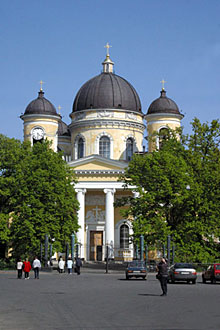 is located on Preobrazhenskaya Ploschad just off Liteiny Prospekt, an area
once home to the Russian Army's prestigious Transfiguration Regiment. The beautiful square outside the
cathedral is home to an impressive array of cannons that were used by the regiment to repel the Turks at
Varna, an extravagantly decorated fence, and two historic and important icons. It is one of the most
visited cathedrals in the city.
is located on Preobrazhenskaya Ploschad just off Liteiny Prospekt, an area
once home to the Russian Army's prestigious Transfiguration Regiment. The beautiful square outside the
cathedral is home to an impressive array of cannons that were used by the regiment to repel the Turks at
Varna, an extravagantly decorated fence, and two historic and important icons. It is one of the most
visited cathedrals in the city.
Peter the Great's daughter Elizabeth came to the area on the night of November 24, 1741, to gain the
backing of the soldiers of the Transfiguration Regiment for her coup against Empress Anna and her
appointed successor, the two-month-old Ivan.
After her accession to the throne on December 7, 1741, the new Empress Elizabeth ordered the
construction of a church on the site as a sign of gratitude. Construction work began on the church
on June 9, 1743, when Elizabeth herself laid the first stone in the foundation of the church.
The architect Mikhail Zemtsov was commissioned to design and build the church, but after his sudden
death in 1743 Antonio Trezzini actually carried out the construction. The church was consecrated on the
eve of the Feast of the Transfiguration, and was declared a cathedral by order of Empress Elizabeth on
August 5, 1754.
Bartolomeo Rastrelli was also actively involved in the construction of the cathedral as well as the
furnishing of its interior, designing the outstanding gold iconostasis of the cathedral and the
altar vestibule. The artist M. L. Kolokolnikov painted the form of the iconostasis.
The church almost burnt down on August 8, 1825, but the icons and iconostases were rescued. The
architect Vasily Stasov was assigned the job of building a new church on the site. Construction on the
Transfiguration Cathedral began in 1827, and was completed quickly. The new church was consecrated on
August 5, 1829.
A beautiful square was laid out around the new church in 1830, according to Stasov's plan. The square is
surrounded by an extraordinary ornamental fence consisting of cannon trunks with muzzles placed on top,
and united with fat iron chains. The cannon trunks were held firm by 34 granite foundations. Three bronze
trunks were placed on each foundation. The middle trunk of the cannon on each foundation was topped with a
crowned gold two-headed eagle. After the revolution, the eagles were taken down, but the rest of the fence
remains more or less in tact.
Twelve cannons on gun carriages were also arranged around the cathedral. The cannons helped the regiment
repulse an attack by the Turks in a battle outside Varna. At first, Nicholas I gave these cannons to Poland
in memory of King Stanislav and Polish soldiers that died outside Varna. But during the uprising of 1831,
the Poles turned these cannons ironically against Russian troops before the cannons were taken with fight
by the Russians for a second time and ultimately returned to the Guards.
A chapel was built near the cathedral, and in 1988 it was restored and is in excellent condition.
Unlike most other churches in the city after the revolution, the cathedral never closed, and today remains
one of the most visited cathedrals in the city.
 Next
Next